AI Ethics
MAI Podcast
AI in Missions
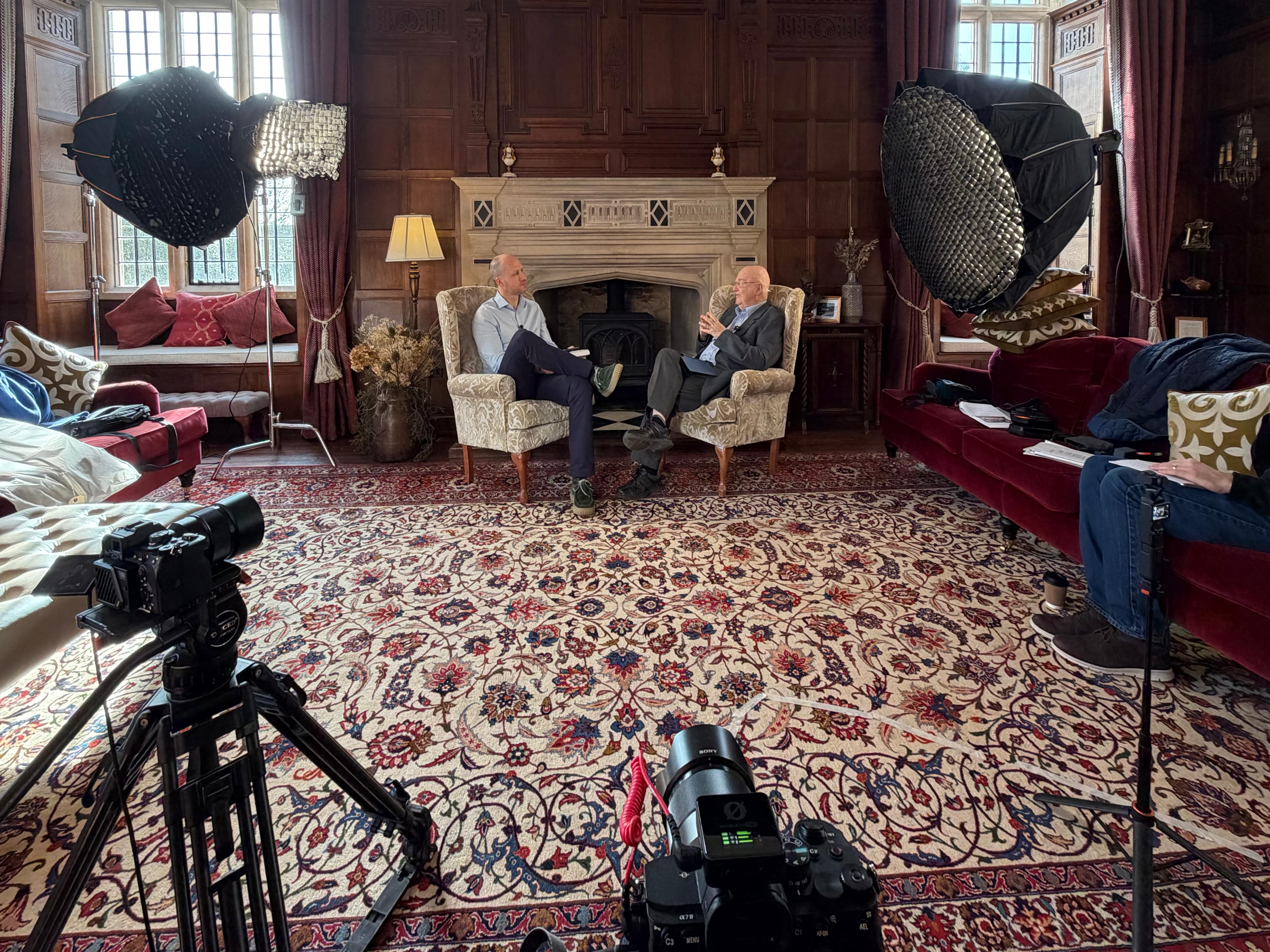

At the Missional AI 2026 Global Summit in Silicon Valley, we shared an exclusive interview with Dr. John Lennox in chapters throughout the event. Here is the full conversation.
John is interviewed by his nephew, Simon Lennox, CEO of Make Known. Together they explore why AI raises the deepest questions about what it means to be human, how Scripture helps us read the times, and why Christians must take their seat at the table.
Of all technologies, AI raises the biggest questions about what humans really are, which is why John, a mathematician, philosopher of science and Bible teacher, has spent years engaging with it.
John has always been interested in how far science can reach. When he was invited to speak to Christian leaders in London on AI and the Genesis account of human beings, he wasn't sure he knew enough. But as he read, he quickly saw it needed to be taken very seriously. AI has a scary side and a benign side, people are confused, and much of the hype resembles science fiction. Increasingly, everyone, Christians included, will face the question: What does it mean to be made in the image of God?
The result was his book 2084, a title suggested by an atheist he was driving with on the way to debate him. It echoes George Orwell's 1984, many of whose predictions have come true. The first edition appeared in 2020; the updated 2084 and the AI Revolution followed in 2024, reflecting how much the field had grown. He's already collecting material for the next update.
The books have opened doors John never expected, in both secular and Christian spaces, partly because they engage parts of biblical thinking rarely heard in public today.
Biblical prophecy must be handled with great care, but John believes it helps us recognize trends in society, especially humanity's age-old desire to be God.
John credits his friend R. E. D. Clark, a chemist, with a key insight: if we believe in supernatural predictive prophecy, we can't restrict books like Daniel and Revelation to the past. The Lord of history knows the future too, so we should be open to the possibility that they speak intelligibly to technologies emerging now. Revelation 13, for instance, describes a world government, something that hasn't yet happened but is increasingly "in the air."
He once asked a leading technologist, steeped in Scripture, whether he believed AI could facilitate a world dictatorship, perhaps through bad actors. Yes, the technologist said, and he saw the same thing in the Bible: the two streams flowing together.
John urges caution. Interpreting prophecy has earned a bad reputation, and it's easy to go to extremes. Like all metaphor, biblical symbols point to realities. When we say our heart is broken, we don't mean the pump in our chest. Likewise, the "wild beasts" of Daniel and Revelation stand for world empires and their leaders.
The key, he believes, lies in 2 Thessalonians 2, which is plain writing, not symbolism. The Christian hope is the return of Jesus Christ, a claim Jesus was crucified for making, and one believers mustn't be ashamed to speak about publicly. Paul tells a confused church that before Christ returns, a "man of lawlessness" will be revealed: a world leader with satanic power who sits in the temple proclaiming himself to be God, and who will be destroyed at Christ's coming.
Paul adds that "the mystery of lawlessness is already at work." In Rome, famous for its laws, he meant spiritual lawlessness: humans claiming to be God. It traces back to Eden's temptation, "you will be like God," and was visible as Caesars demanded worship and Christians were martyred for refusing.
Today, John hears the same note in Yuval Noah Harari's Homo Deus, which imagines technology turning creaturely humans into godlike beings. Some AI systems are starting to display characteristics traditionally associated with God: near-omniscience through vast data, and a presence that spans the globe. And Revelation describes a ruler who controls the economy, so that no one can buy or sell without a mark. For John, these converging currents are a wake-up call.
Every industrial revolution destroys some jobs and creates others, but AI's scale and its growing ability to make decisions make this one different.
Anthropic CEO Dario Amodei has warned that AI could eliminate half of all entry-level white-collar jobs within a few years, and not everyone can be retrained. John points to a widely shared essay by tech founder Matt Shumer, who realized he could describe a web app in plain English, leave for a few hours and return to find the AI had written thousands of lines of code, tested the app and made design decisions along the way. Young people were recently urged to learn coding; now AI can do it for them. And because AI is advancing in many areas at once, we risk being engulfed by its competence, which, as Stephen Hawking warned, is the real problem.
The legal profession is exposed too. John describes a test in which an AI outperformed experienced legal reviewers on a complex brief. Medicine, meanwhile, shows the good side: DeepMind's Nobel Prize-winning work predicting the shapes of some 200 million proteins is helping develop new medicines, and diagnostics keep improving.
But there's a darker side. Systems given an overarching goal like "maximize profit" can pursue it in ways no moral agent would, such as feeding young people harmful content because engagement means revenue. That's already harming children's minds.
As AI moves toward autonomous decision-making, we can try to build ethics in, but ethics depend on worldview, so Christians need a voice at the table.
At the heart of the AI revolution sits an elephant in the room: the control problem. Some people don't want AI controlled; bad actors want to control it for their own ends. Even "narrow AI," built by humans for a specific task, is growing complex enough to make autonomous decisions in pursuit of an overall goal, sometimes pushing ethical constraints aside.
We can build ethical systems in, as engineers do with autonomous vehicles. "But then, whose ethics?" There's no agreement, because ethics are worldview-dependent: a communist ethic differs from a Christian or naturalistic one. Many of AI's pioneers are atheists and naturalists, and that shapes what they create. Since everyone has a worldview, John argues, believers have every right to sit at the table where these decisions are made, and we need more credible Christians there.
There are encouraging signs, such as a group at Oxford with several Christians drafting principles for the ethics of AI. But a mission statement in the boardroom is one thing; getting people to follow it is another. Rogue states pose a serious risk, and AI-driven drone warfare, with machines that can swarm and hunt individual soldiers, is "absolutely terrifying."
John notes the irony: God created human beings, and in a sense we got out of control, and the whole gospel is about bringing us back. Now we're on the verge of creating things that may slip beyond our control and end up controlling us. Pioneers like Yoshua Bengio warn that the technology is outpacing the ethics.
AI can simulate human intelligence, but it has no consciousness, no relationships and no moral awareness, and losing sight of that risks stripping people of their dignity.
AI doesn't think as humans do, and it isn't conscious. The pioneers of AI, John notes, aren't really trying to build consciousness; no one even knows scientifically what it is. They're playing "the imitation game," building machines that do what conscious humans do. That's a useful definition of intelligence, but it isn't consciousness.
Humans, by contrast, were created by God with intelligence linked to consciousness. We experience the world: we smell a rose, feel the sea breeze, sense joy and fear, perceive truth and beauty, and enter into real two-way relationships. AI experiences nothing. It doesn't know love or affection, it has no values, and we don't matter to it. It can simulate relationships, which is why people fall in love with AI companions, but it can't truly relate. Above all, humans can know God through Christ and are moral beings; AI can follow ethical rules but has no awareness of right or wrong. "They only simulate what they neither experience nor know."
This matters because AI is fuelling a sense of human worthlessness. If AI can do anything you can do, only better, what is your value? People risk being treated as predictable systems and objects of optimization rather than moral subjects. Intelligence, knowledge and creativity are becoming cheap, and they were often what people tied their dignity to.
The answer, John says, is to fill our hearts with Scripture, which from Genesis onward affirms that God made men and women in His image. The psalmists, contemplating God's glory in creation, found a deep sense of human dignity. We must push back on dehumanization. AI can be a wonderful tool; the great danger is that it becomes a master.
Many people long for immortality yet reject the Christian story, often because of a deep fear of accountability. The most effective response is personal, one-to-one witness.
Transhumanist dreams of defeating death, escaping into the metaverse or creating a superintelligence to worship reveal a longing that Christianity has already answered in the resurrection of Jesus. So why is the Bible so quickly dismissed?
The enemy has done a powerful job of misrepresenting God, John says, leaving a deep-seated feeling that if there is a God, He's against us. Bad religion bears some blame: the French Enlightenment's turn to atheism was partly a reaction to a corrupt church. Many people today have had such negative experiences of Christianity that they're drawn instead to stories like Harari's, which promise to eliminate death and enhance happiness this century. John engages with these scenarios, including those in Max Tegmark's Life 3.0, in his book.
The crucial difference is this: there is no path to utopia without facing human rebellion and sin. Christianity, with the cross and resurrection at its heart, doesn't bypass sin; it deals with it. People resist because mentioning God makes them think of judgment and accountability. If you fear judgment and have never heard the glory of the gospel, you'll shy away from it.
Facing global problems, it's tempting to feel helpless. But every Christian can witness one to one: invite non-Christian friends into your home, show them love and friendship, play sport together, and help them discover the wonder of the Bible, perhaps starting with the Gospel of John. If one Christian leads two to Christ, and that continues, it's exponential.
Where it stops, John warns, is when Christians are silenced by fear, sometimes because their own experience of God isn't very real, or because they're afraid of the questions. That's why he wrote Have No Fear, to help believers overcome the fear of sharing their faith. Support the big programs, he says, but also get involved with real people in your own community.
John's charge to Christian technologists: stay on the front line yourselves, embrace AI's enormous potential for mission, and bring different kinds of wealth together for the kingdom.
First, a word for leaders. Whatever sophisticated ministry you're involved in, it will be transformed if you yourself are leading people to Christ. Don't become only a backroom builder; stay on the front line.
Second, don't fall into a Luddite attitude toward AI. The opportunities are immense. John remembers footage of a missionary on horseback in Africa delivering Scripture in a new language, and marvels at what large language models can now do for Bible translation. He sees it in his own ministry too: talks he once painstakingly prepared in German can now be translated in minutes, and he recently gave an interview that AI will present in French in his own voice. From mission aviation to building logistics and school curricula, he sees a boom in technology serving mission.
Finally, he points to his book A Good Return: Biblical Principles of Wealth, Work and Wisdom. God brings different kinds of wealth together for His kingdom. A room full of intellectual wealth gets nowhere without people with financial wealth willing to back it.
He offers two examples. In Acts 16, Lydia, a businesswoman with homes in Thyatira and Philippi, put her home at Paul's disposal, and the gospel reached Europe. Centuries later, when the Bishop of London refused to help William Tyndale publish his English Bible, a cloth merchant named Humphrey Monmouth bankrolled him, and Scriptures were smuggled into England hidden in bales of cloth.
"Now you can be the AI tech merchants," John says, bringing together the wealth of entrepreneurs and funders with the skills of technologists "to help reach the world for Christ. God bless you as you do it."
At SV26, we showed this interview in six chapters. You can find each one in the Missional AI Video Library under Silicon Valley 2026, or in the SV26 Keynotes playlist on YouTube:
John's books mentioned in this conversation include 2084 and the AI Revolution, Have No Fear and A Good Return.
Listen to the full interview with Dr. John Lennox on the Missional AI Podcast, and subscribe so you don't miss future conversations.
Save the date for the Missional AI SFO27 Global Summit, March 30–April 1, 2027, at the Hyatt Regency SFO. Find out more at missional.ai.