
AI Ethics
AI in Missions
Ministry Innovation
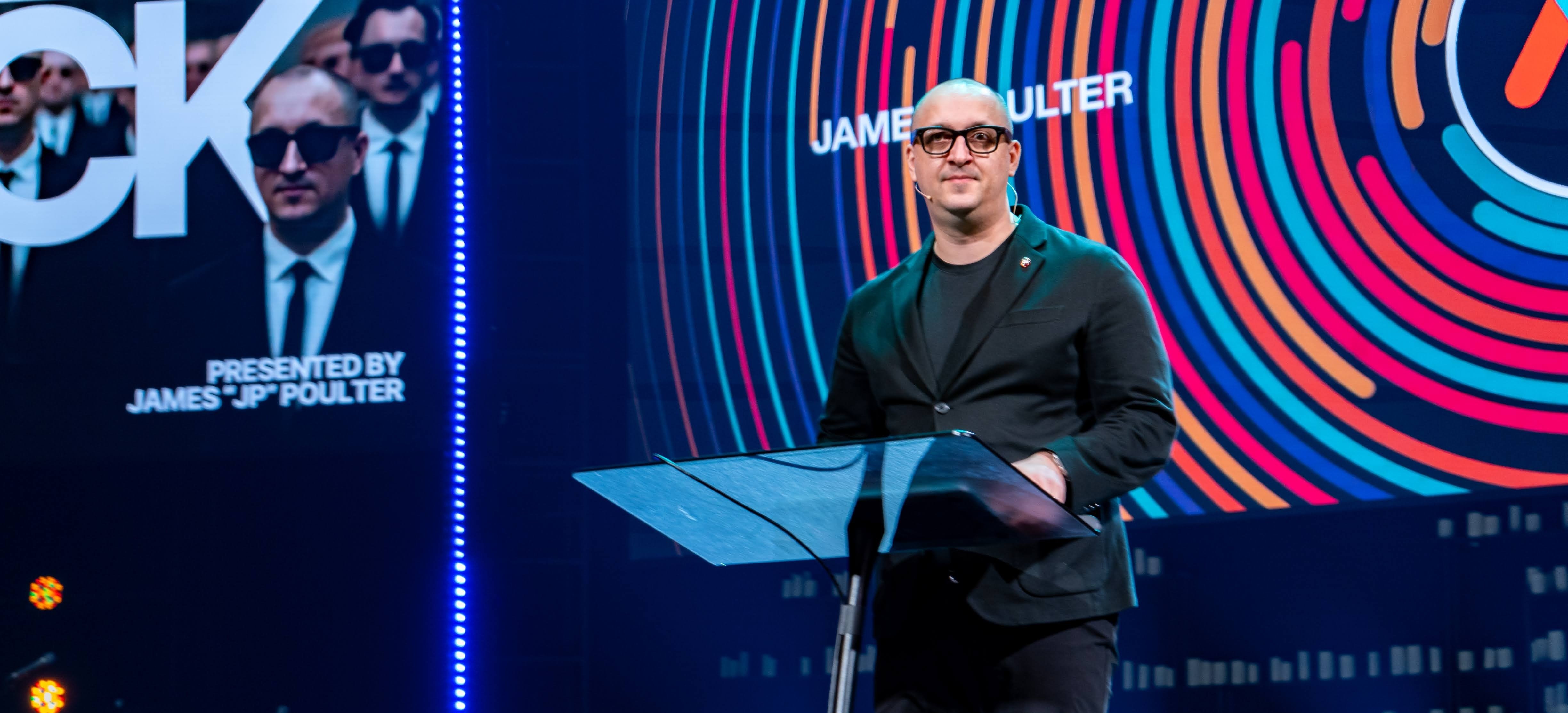

AI is about to change what it means to work, and James Poulter believes the church is uniquely placed to lead through that change rather than fear it.
James, known to most as JP, heads up AI and innovation at House 337, a London-based creative company. He also serves on the board of Christian Aid and advises the team at CV (Christian Vision). He spends much of his time thinking about how AI will reshape what it means to be human.
We sat down with JP at Missional AI 2025 in Dallas to ask where AI is heading over the next few years, what the much-discussed AI 2027 report means, and what churches and ministries should actually do now.
AI capability is expected to rise sharply in the next few years, and the real constraint will be how fast humans and institutions can change.
JP is careful about predictions. Five years ago, many expected the 2020s to roar upward, and nobody saw what was coming. Still, he says, teams across the major AI labs broadly assume these models will grow dramatically more capable very soon.
What holds that potential back is us: our systems, our processes and, above all, our politics. It's the same story as every recent technology wave. Ministries played catch-up with the web, then mobile, then social media. The technology was ready; entrenched habits and administration were not.
The twist this time is that AI may take over many of the very functions that slow us down. Remove that limiting factor, and the question becomes which parts of the work humans should still do.
If your work is mostly moving information or holding conversations through a screen, AI will be able to do much of it, but the thinking and relating behind it stays human.
JP's test for a knowledge worker is simple: could you do your job without a computer? If not, you're likely in the knowledge economy, alongside people in software, legal services, HR and education. Almost everything in that sector, he says, is on the table.
Over the past decade, that work has splintered into ever more specialized roles and titles. That brings structure and career paths, but also constant confusion about whose job is whose. As AI absorbs that complexity, what's left for people is what JP calls "the squishy stuff": the physical, embodied, relational work.
AI may get better at reading emotion, but it only ever sees digital context. People carry far more. So JP's priority is helping people at every career stage grow in empathy, leadership, strategy, critical thinking and relationships, and then equipping them to put AI to work on the rest.
The AI 2027 scenario predicts that once AI can help train itself, progress shifts from additive to multiplicative, compressing a century of research into months.
JP expects models to keep getting faster, smarter, better and cheaper, though they'll demand more chips, energy and compute. The AI 2027 report, written by researchers including former OpenAI staff, assumes AI becomes increasingly better than humans at training AI. Run millions of copies in parallel, and work that would take people a hundred years could happen in a hundred days.
He stresses that this won't be a single overnight switch. Agents will go from reliable to super-reliable to super-capable in stages, across coding, writing and visual work alike.
And today's tools are already far more capable than most people realize. JP estimates that about 90% of people use around 10% of what their AI tools can do, much as most of us barely scratch the surface of Excel.
When our ancestors discovered fire, JP notes, they didn't have blowtorches the next day. The challenge now is how to put a technology this potent into people's hands safely. The AI 2027 report also highlights a global race between superpowers, the kind of pressure that pushes ethical and copyright concerns aside. The risk is that we hand everyone a blowtorch by accident, or simply to keep up with competitors.
Safety features only work when people choose to use them, so JP wants individuals to take responsibility for their own AI use now, before a crisis forces it.
Will the race strip away every safeguard? Yes and no, says JP. Governments, labs and institutions will feel heavy pressure not to fall behind. But history shows that once we see the danger, we pull back.
His analogy is the car. Formula One cars can top 186 mph, yet that's not what happens on the highway. We added seatbelts, then traffic lights, speed bumps and low-emission zones. But what made the biggest difference over the past 30 to 40 years was public information campaigns in the US and UK that taught people to buckle up.
As social media has shown, controls alone aren't enough. JP's question for us: what is the AI seatbelt campaign? How do we help people take ownership of their own data, training and model use, so we never need a mass shutdown or a kill switch?
Experiment with AI today, and plan now for the hard question: what you'll do with the people whose tasks AI takes over.
The bleeding edge doesn't stay sharp for long. ChatGPT is only a couple of years old, and already not using it seems odd. JP says he'd be worried about any ministry that isn't experimenting, because no one should be left behind.
JP is no AI doomer. He sees a huge opportunity to strip administrative grunt work out of ministry. But he flags a hidden cost. Entry-level work is often how people stay in an organization long enough to grow into leaders. Remove the work and the economic reason to employ them, and you remove that path too.
He sees it in call centers, where an AI agent can now handle work that once needed perhaps half the staff. Every organization then faces a choice: cut people, or retool and redeploy them. For a ministry with flat donation income, could AI-augmented teams mean a third more reach? JP hopes so, but the people doing that work will be doing different jobs.
His framing: a role may become economically unviable, but the person never is. Ministries need to get creative about what that person does next. Education, social care, elder care, pastoral ministry and worship are all areas where people remain essential.
In a deliberately provocative take, JP says he isn't upset about social media manager roles disappearing. They've existed for a sliver of human history, while the church's core work has endured for two millennia: discipleship, evangelism, teaching, serving the poor.
His practical advice for a small ministry: before hiring a social media editor, CRM strategist or major-gifts writer in the next six months, ask whether a human will really be doing that job in a year. If AI can do it for close to nothing, put that budget toward what only people can do: meeting needs and building relationships.
Unlike businesses chasing margins, ministries aren't trying to bank the savings. That makes this a real window to multiply impact. And as commercial companies shed jobs, JP believes the church is uniquely placed to help, perhaps even by welcoming displaced workers into mission-driven work.
Imagine a letter announcing that aliens are coming, no smarter than us but 10,000 times faster, arriving in five months, five years or fifty. Would you prepare differently tomorrow? Of course. That, says JP, is our situation. It's not a question of if, only when.
This conversation picks up where JP's Missional AI 2025 keynote, "How to Become a 'Full Stack Professional'," left off. You can find it in the Missional AI Video Library under Dallas 2025 Keynotes.
In the interview, JP describes his focus as helping people rethink which parts of the "work stack" humans should own as AI takes on more knowledge work. The keynote is where he lays out that idea in full. Watch it alongside this episode for the complete picture.
JP finds it strange that anyone thinks the church isn't a place of innovation, since it was founded by the person who did the most innovative thing in history.
Jesus overturned tables, showed new ways of living and walked up the hill to the cross. We are called to model ourselves on Him, and to be creative as we reflect our Creator. If the church truly believes that, JP says, we will be the ones who lead the way.
He also rejects the nihilism that can creep into AI conversations, where humans end up as mere fuel for machines. That isn't what he reads in Scripture. At the end of Revelation he sees a city being restored, and our job is to work with God in that restoration. God has always used technology toward that end, and He is using it now. Whether we're among the first nine billion people on this planet or the last, we get to partner with Him in it.
Listen to the full episode with James Poulter on the Missional AI Podcast, and subscribe so you don't miss future conversations.
JP will also be speaking at Missional AI London on July 17, a one-day gathering of leaders from across Europe and the Middle East. Find out more and register at missional.ai.
This episode was made possible in partnership with Gloo, the technology platform connecting the faith ecosystem.